Why Today's Date (4.14) Is Actually a Physics Lesson Hiding in Plain Sight
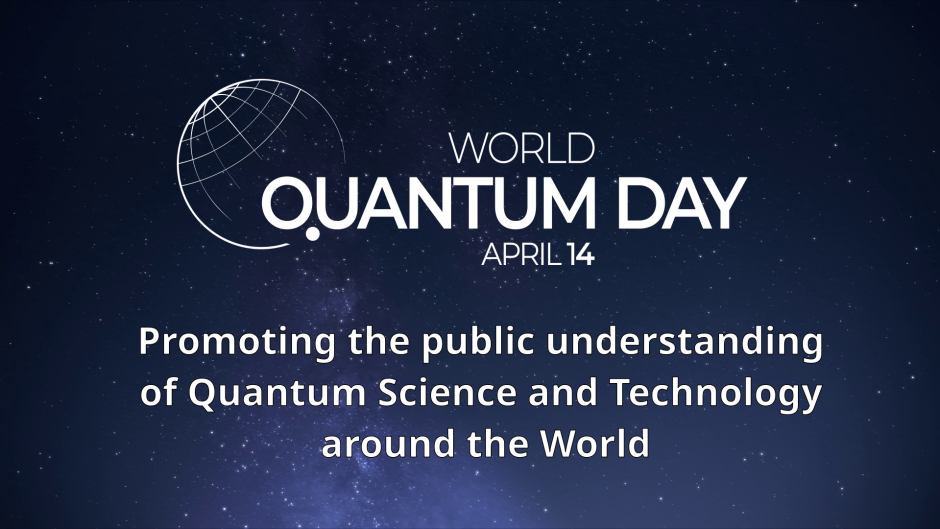
Happy World Quantum Day
Yes, that's a thing—and honestly, it's one of the few "international days" that actually earns its spot on the calendar.
If you've seen Google's Doodle today and wondered why April 14th of all days was chosen to celebrate something as mind-bending as quantum mechanics, the answer is delightfully nerdy. It's a nod to 4.14, the first three digits of Planck's constant (4.14 × 10⁻¹⁵ eV·s)—the fundamental number that basically told physicists, "Hey, energy doesn't flow smoothly like water from a tap. It comes in tiny, indivisible chunks called quanta" .

That discovery in 1900 broke classical physics wide open. Before Planck, the assumption was that energy was continuous—you could have half a unit, a quarter unit, whatever. Planck's constant revealed the universe has a minimum transaction size. You can't Venmo nature 0.3 quanta. It's all or nothing .
And that's what we're celebrating today. Not just a number, but the door it cracked open to everything from quantum computers to sensors so sensitive they can detect gravity changes from underground tunnels.
Here's a fun bit of trivia to drop at lunch: today's date, April 14 (4.14), is no coincidence. It's the first three digits of Planck's constant—the number that told physicists over a century ago that energy doesn't flow smoothly like honey from a jar. It comes in discreet, indivisible packets called quanta. That single insight shattered classical physics and birthed the weird, wonderful, deeply counterintuitive world of quantum mechanics.
And that's why April 14 is World Quantum Day—a global celebration that's grown from a scientist-led grassroots initiative in 2021 to a genuinely international movement spanning over 65 countries.

What's Actually Happening Today (And Why It's Not Just for Physicists)
If you think quantum science is locked away in university basements behind cryogenic cooling systems and walls of equations, today is designed to prove you wrong. The whole point of World Quantum Day is to drag this field out of the lab and into public view—because it's about to reshape everything from your phone's security to the drugs in your medicine cabinet.
Across the planet, events are unfolding that have nothing to do with dry academic papers:
In Europe, DESY in Hamburg is hosting open discussions on their 50-qubit quantum computer collaboration between QUDORA and NXP. This isn't theoretical—it's hardware that exists, running algorithms that classical supercomputers choke on. Over in Spain and Norway, universities are throwing open their lab doors for tours and hands-on demos.
In Southeast Asia, Vietnam and the Czech Republic are running student workshops and public lectures aimed at demystifying superposition and entanglement for people who last studied physics in high school.
Across North America, dozens of US universities—from MIT to community colleges—are hosting webinars, hackathons, and Q&A sessions with researchers. The theme is consistent: You don't need a PhD to understand why this matters.
In Latin America, Africa, and South Asia, local quantum communities are organizing meetups, coding sessions, and panel discussions. Pakistan's National Centre for Physics, for instance, recently ran a quantum computing hackathon that drew nearly a thousand applicants—proof that curiosity about this field is truly global, not confined to the usual tech hubs.
Industry is leaning in too. Google Quantum AI, IBM Quantum, IonQ, Quantinuum, and a wave of startups are using today to spotlight real-world applications: drug discovery simulations that could slash development timelines, materials science breakthroughs for better batteries, and yes, the looming challenge of quantum-resistant cryptography.

Why You Should Care (Even If You're Not a Scientist)
Here's the honest, no-hype version. Quantum computers aren't going to replace your laptop next year. The machines we have today are noisy, error-prone, and require temperatures colder than deep space to function. Scaling them to fault-tolerant, commercially useful systems is an engineering mountain that'll take years—maybe a decade—to climb.
But the trajectory is real. And the implications touch everything.
- Security: The encryption that protects your bank transactions, private messages, and government secrets? Quantum computers will eventually crack it. Researchers call it "harvest now, decrypt later"—adversaries are already hoarding encrypted data, betting that quantum machines will unlock it within the decade. The race for quantum-safe cryptography is on, and it's not a drill.
- Medicine: Simulating molecular interactions is brutally hard for classical computers. Quantum approaches could model protein folding and drug interactions with unprecedented accuracy, potentially cutting years off the path from lab to pharmacy.
- Climate and Materials: Designing better catalysts for carbon capture, more efficient solar cells, or lighter, stronger alloys for transportation—all of these are quantum chemistry problems at their core. Classical simulations are approximations. Quantum simulations could be the real thing.
- Navigation and Sensing: Quantum sensors are already sensitive enough to detect gravity changes from underground tunnels or mineral deposits. Imagine navigation systems that don't rely on vulnerable GPS satellites.
The Day's Real Message
World Quantum Day isn't about making everyone an expert. It's about ensuring that when quantum technology starts reshaping industries—and it will—the public conversation isn't starting from zero. It's about transparency, access, and a little bit of wonder.
Because at its heart, quantum mechanics asks us to accept things that sound absurd: particles that exist in multiple states at once, cats that are both alive and dead, and a universe where simply observing something changes its behavior. It's the closest thing physics has to magic, and it's all real.

So here's a question for the comments: What's the one quantum concept that still makes your brain itch? Schrödinger's cat? Spooky action at a distance? Or the fact that you're mostly empty space held together by probabilities? Drop it below—let's get weird with it. 👇
Comments (0)
Leave a Reply
No comments yet. Be the first to start the discussion.